
Today’s financial services organizations recognize that success starts with strong relationships built on trust and transparency. In a competitive market, a company’s employees can make or break these crucial relationships through their interactions with customers. That’s why businesses — from wealth management and insurance firms to banks and credit unions — are investing in automated workforce solutions to help them attract, engage, and retain top talent while controlling costs and driving exceptional service.
Managing a diverse workforce of exempt and nonexempt employees across back-office, contact center, and frontline operations is no easy feat. Finding and keeping best-fit employees is challenging enough, but you also need to optimize day-to-day functions like time and attendance, scheduling, payroll, labor cost and productivity tracking, and compliance management to stay competitive and profitable. Given this complexity, it is not surprising that management teams are not always leveraging their workforce processes and technology for maximum impact.
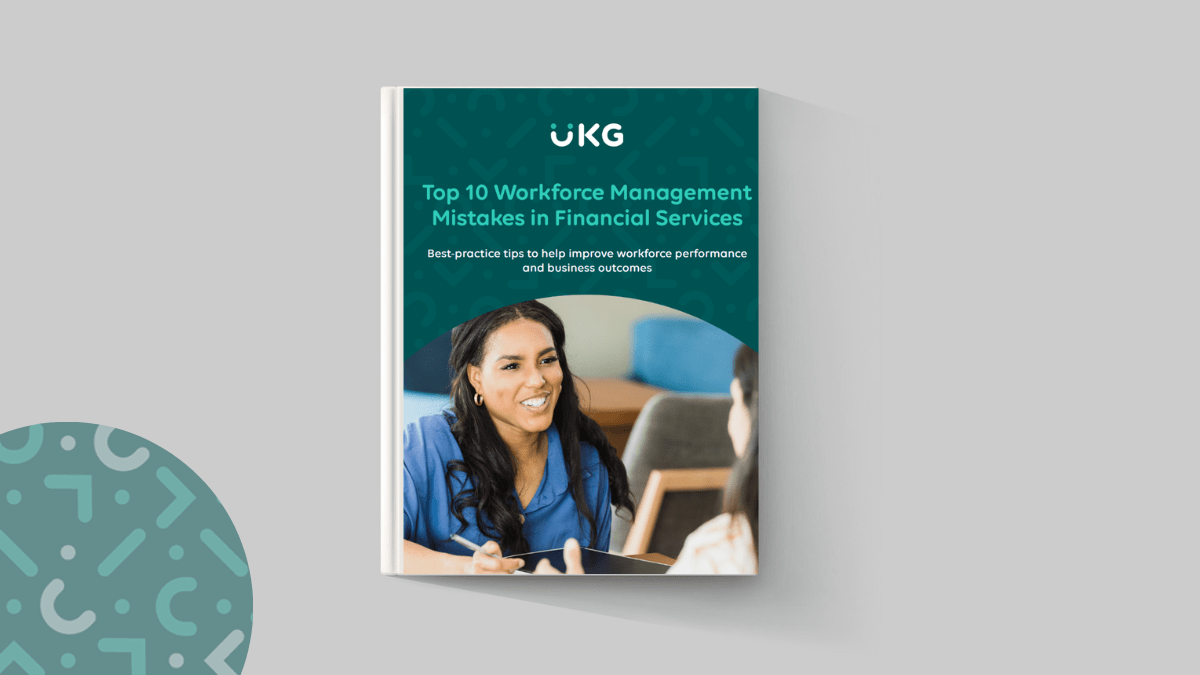
This paper discusses the top 10 workforce management mistakes made by financial services institutions and how to avoid them. It also provides best-practice tips for improving your organization’s performance — and business results — moving forward.
Included in this guide:
- Trying to manage labor compliance with outdated systems and processes
- Providing a substandard mobile experience for human resources (HR), scheduling, and timekeeping
- Enforcing absence policies inconsistently and accruing time off manually
- Looking the other way when hourly employees do not adhere to optimized schedules
- Relying on manual and semi-automated systems for time and attendance management
- Depending on disparate systems for a holistic view of the workforce
- Neglecting to keep tabs on evolving employee expectations
- Staffing to achieve the lowest labor cost without accounting for employee engagement and customer service
- Failing to consider employee performance when determining the optimal staffing mix
- Lacking a data-driven approach to optimizing workforce utilization and performance
This article is posted at ukg.in

Please Fill Out The Form To Access The Content