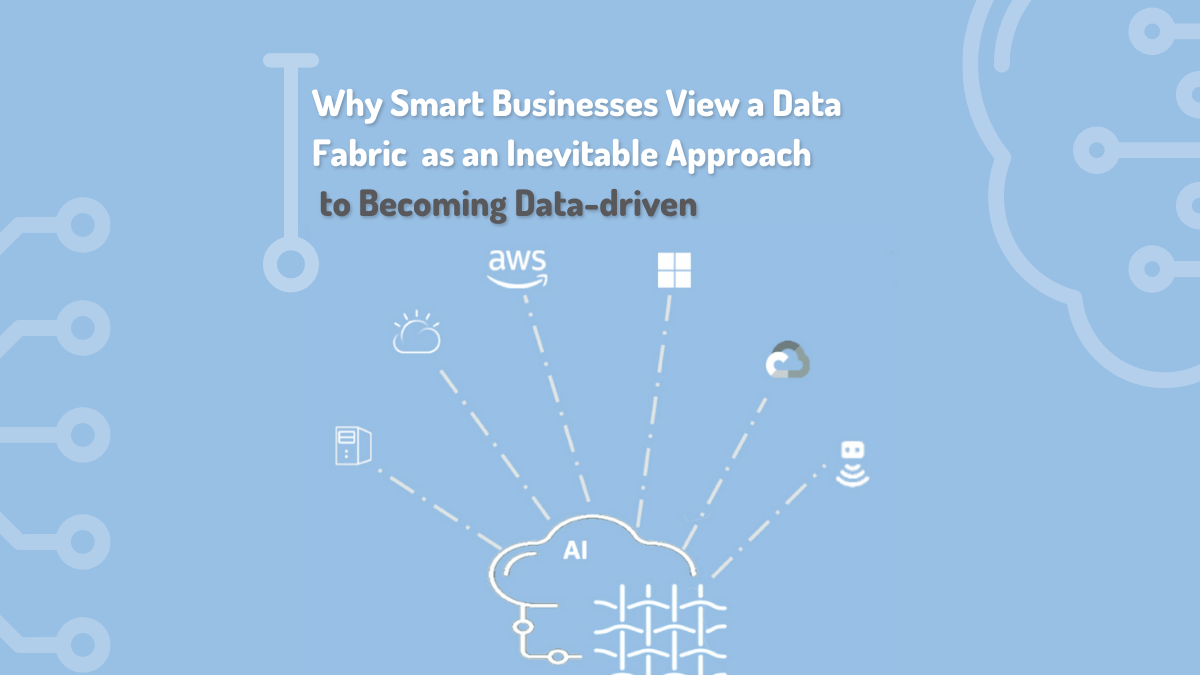
Business executives know that their company needs to adopt a data-driven strategy. However, gaining value from data remains a massive challenge, despite the fact that businesses are drowning in data. As businesses begin to adopt a distributed hybrid computing strategy, they must figure out how to achieve a unified view of all of their data. Simply put, you cannot achieve a hybrid computing strategy if you can’t abstract data from its underlying location. To be successful, business leaders need to have the ability to gain an understanding of the holistic view of data across any location, any cloud, and any application. The business requirement to analyze and manage your data — no matter where it resides — has given rise to an emerging approach and architecture, called a data fabric.
For decades management has demanded the capability to unify data across silos but they have been without success. For example, IT organizations created data warehouses or data lakes to serve as a centralized repository for data, but these attempts required moving large amounts of data, and a supporting organization to continually manage, update and secure the environment. The situation has only gotten more complicated as the amount of data and the number of data sources continues to expand.
The key to business success in an environment of continual change is the ability to turn your data into a strategic and manageable asset. Unfortunately, understanding your data in context and across teams and environments remains a major challenge. In this paper, we will discuss why businesses are starting to adopt a data fabric approach that allows you to connect to your data no matter where it resides. This defining characteristic of a data fabric will allow businesses to more effectively use their information as a strategic business asset. A data fabric is the only practical approach to creating the next generation of data management by delivering a manageable, predictable, and resilient platform with the help of artificial intelligence and machine learning. Automation and built-in AI will allow the data fabric to be flexible enough to support your evolving data landscape without the need for constant stewardship. In addition, we will provide an update on IBM’s journey to establishing an intelligent data fabric in the next generation of IBM Cloud Pak for Data.
Please fill out the form to access the content
Resource Sponsored hurwitz.com